

How 3D Vision-Guided Robots Automate Plastic Pellet Bag Depalletizing
In plastic processing plants, plastic pellets are commonly supplied in 25 kg or 50 kg bags and stacked on pallets for storage and transportation. Before these materials can enter production, the bags need to be unloaded from pallets and, depending on the production process, opened to release the plastic pellets into a feeding or conveying system.
When these operations rely on manual labor, they can be time-consuming and labor-intensive. Workers must repeatedly handle heavy bags, while production teams need to maintain a steady supply of raw materials to support continuous manufacturing.
HANCHINE's 3D vision-guided robotic solution is designed to automate the handling of plastic pellet bags, helping plastic manufacturers improve operational efficiency and reduce their reliance on manual labor.
Unlike logistics depalletizing systems designed to handle cartons, parcels, or mixed warehouse loads, this solution focuses specifically on bagged plastic raw materials used in plastic processing.
1. What Is a 3D Vision-Guided Depalletizing Robot?
A 3D vision-guided depalletizing robot uses three-dimensional vision technology to identify the positions and spatial arrangement of bags stacked on a pallet.
In conventional robotic applications, objects often need to be placed in predefined positions. However, plastic pellet bags may shift during transportation or storage. Their shapes can also change slightly depending on how the material settles inside each bag.
These variations make it difficult to rely entirely on fixed coordinates.
With 3D vision positioning, the system can obtain spatial information about the pallet load and determine where the bags are located. The robot can then use the positioning data to guide its movements and perform the designated depalletizing operation.
For plastic manufacturers, this approach offers greater flexibility when handling palletized bags of raw materials without requiring every bag to be positioned with perfect precision.
2. How Does 3D Vision Positioning Work?
The 3D vision system is a key component of the robotic solution. Its role is to provide the spatial information needed for accurate robotic operation.
The general process includes the following steps.
Step 1: Scan the Pallet
The 3D vision system captures spatial information about the pallet and the stacked plastic pellet bags.
This allows the system to determine the arrangement of the bags and identify their positions relative to the robot.
Step 2: Identify Bag Positions
Based on the acquired 3D data, the system calculates the positions of the bags to be handled.
This is particularly useful when bags are not perfectly aligned or when their positions vary between pallets.
Step 3: Guide the Robot
The positioning information is communicated to the robot control system, allowing the robot to move toward the target bag according to the programmed handling sequence.
Step 4: Perform Depalletizing
The robot carries out the designated operation to remove bags from the pallet. The process can be integrated with subsequent material-handling equipment according to the customer's production layout.
By combining 3D vision positioning with robotic handling, manufacturers can automate a repetitive operation that would otherwise require continuous manual intervention.
3. Designed for 25 kg and 50 kg Plastic Pellet Bags
Plastic pellet bags are widely used in injection molding, extrusion, compounding, and other plastic manufacturing processes.
Although these bags contain similar types of raw materials, their weight, dimensions, stacking patterns, and packaging characteristics may vary between applications.
HANCHINE's solution focuses on the specific requirements of handling plastic pellet bags rather than general warehouse cargo.
Key considerations include:
Bag weight: Applications involving 25 kg or 50 kg bags require suitable robotic handling and end-of-arm tooling.
Pallet arrangement: Bag positions and stacking patterns influence the robot's positioning and handling sequence.
Production requirements: The depalletizing process should be coordinated with the factory's downstream material-feeding and conveying arrangements.
Factory layout: Equipment configuration should be determined according to available space, pallet transfer methods, and the customer's existing production line.
The final configuration should be evaluated against the actual bag specifications, pallet patterns, operating conditions, and required throughput.
4. Integration with Plastic Material Feeding Systems
Depalletizing is often one part of a larger raw-material handling process in a plastic processing plant.
After bags are removed from pallets, the next steps depend on the factory's production arrangement. Where an automatic bag-opening process is included, the bags can be opened so that the plastic pellets can be discharged into the appropriate material-feeding or conveying equipment.
A typical process may involve:
Palletized plastic pellet bags → Robotic depalletizing → Automatic bag opening → Material feeding or centralized conveying
The exact configuration depends on the selected equipment and the customer's requirements.
For manufacturers operating centralized material conveying systems, automating upstream bag handling can help establish a more consistent material supply process and reduce the need for operators to repeatedly handle bags manually.
It is important to distinguish depalletizing from bag opening: depalletizing removes bags from a pallet, while bag opening creates an opening in the packaging to release the material. These operations can be integrated, but they serve different functions.
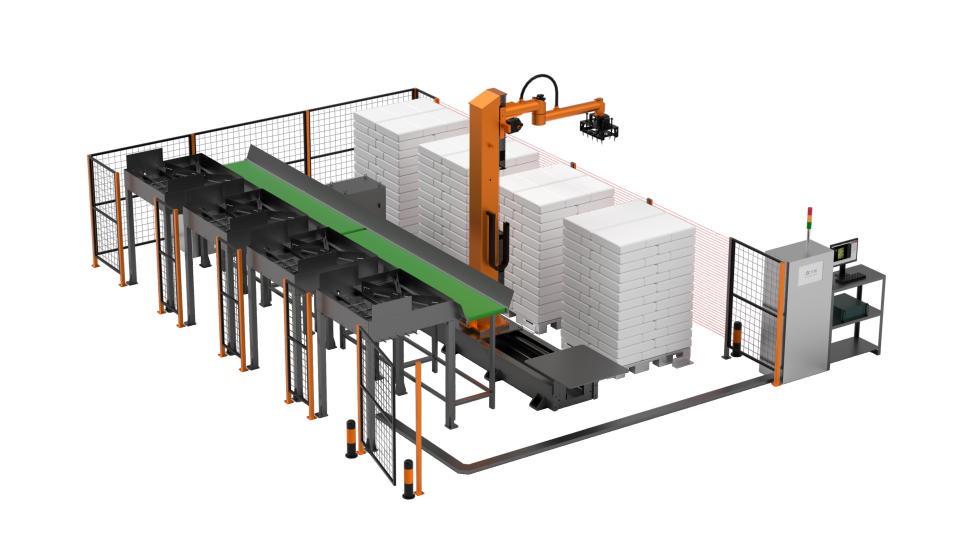
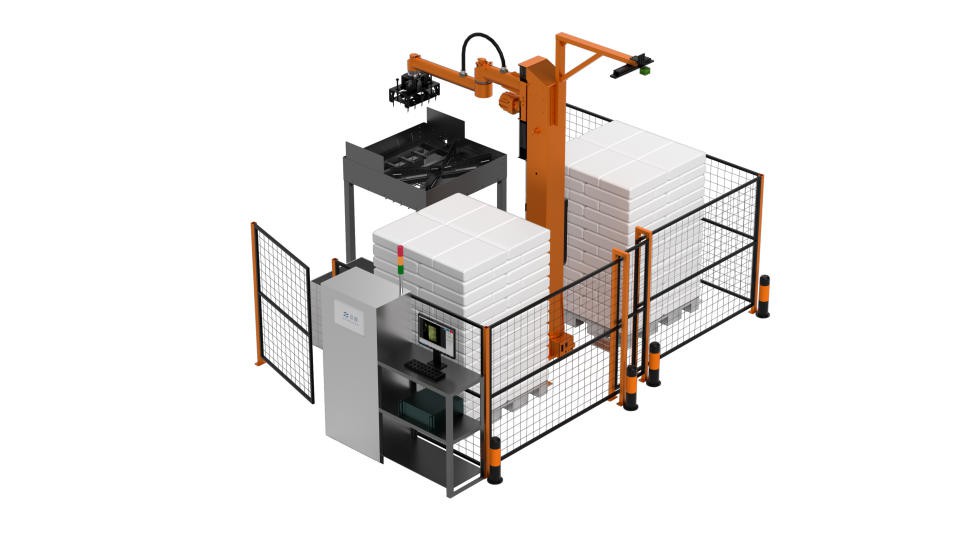
5. Why Automate Plastic Pellet Bag Handling?
Reduce Manual Labor Requirements
Repeatedly handling 25 kg or 50 kg bags places physical demands on workers. Robotic automation can take over designated repetitive handling tasks, reducing the amount of manual labor required for these operations.
Improve Operational Efficiency
Automated handling can help reduce interruptions associated with manual bag handling and support a more consistent workflow when supplying raw materials to production.
Actual throughput depends on the equipment configuration, bag arrangement, pallet exchange process, and downstream operations.
Improve Process Consistency
A 3D vision-guided system uses acquired positioning information to guide robotic movements, helping the system accommodate variations in bag placement within its operating capabilities.
Support Production Automation
Integrating robotic depalletizing with bag-opening and material-conveying equipment can help manufacturers reduce manual intervention across the raw-material handling process.
The benefits achievable in each factory depend on its current workflow, production requirements, and the scope of automation implemented.
6. What Should You Consider When Selecting a Depalletizing Robot?
Before selecting an automated solution for plastic pellet bags, manufacturers should evaluate several practical factors.
Bag specifications: Confirm whether the application involves 25 kg bags, 50 kg bags, or multiple bag formats.
Pallet patterns: Provide details of the stacking arrangement, pallet dimensions, and any variations in bag placement.
Vision and positioning requirements: Evaluate whether the 3D vision system can reliably identify bags under the actual operating conditions.
Required throughput: Determine the number of bags that need to be handled per hour and how the robot will coordinate with downstream processes.
System integration: Consider whether the application requires depalletizing alone or an integrated solution involving bag opening, material feeding, and centralized conveying.
Factory layout: Assess pallet positioning, equipment footprint, operator access, and the material transfer route.
Providing these details allows the equipment supplier to evaluate the application and recommend an appropriate configuration.
7. HANCHINE: Robotic Automation for Plastic Raw Material Handling
HANCHINE develops robotic automation solutions for industrial applications, including automated handling and bag-opening processes for plastic raw materials.
Our 3D vision-guided approach addresses the specific challenges of handling palletized plastic pellet bags, helping manufacturers move toward more automated raw-material handling workflows.
Rather than applying a general-purpose warehouse depalletizing concept to every application, the solution should be configured around the customer's bag specifications, production requirements, and downstream material-handling process.
If your factory currently relies on manual handling of plastic pellet bags, HANCHINE can discuss your application requirements and evaluate a suitable automation solution.
Contact HANCHINE to discuss your plastic pellet bag handling process, including bag weights, pallet arrangements, required throughput, and integration with existing material-feeding equipment.